Showing posts with label indian river. Show all posts

Monday, July 02, 2007

Messer hooks inshore slam worth $1,000


A total of 133 anglers participated in the Riverside Café / Vero Tackle Inshore Fishing Tournament on Saturday. But no one won as big as Wayne Messer.

Messer took home a $1,000 payout for catching a slam of trout, redfish and flounder, which weighed in at 10 pounds, beating out Bruddy Tyson's slam of 9 1/2 pounds.

Most of the big trout were caught early in the morning on topwater plugs. Derek Seiger won $750 in the trout division, finishing first with a weight of 7 1/2 pounds. Mike Olvey won the redfish division and $750, with a fish weighing in at 6.6 pounds.

Colin Willis won the junior angler slam, catching a ladyfish (.85 pounds), a jack (1.3 pounds) and a sheephead (2.05 pounds) to win a rod, reel, cast net and $100. Cody Ward won a rod and a reel in the junior division as well.

Tuesday, June 05, 2007

Breast cancer survivors enjoy fly fishing with event


By DAVID THOMPSON - dthompson@sungazette.com
DAVID THOMPSON/Sun-Gazette

Diane Chesnut vainly attempts to interest a pair of large trout into taking a bite of her Wooly Bugger fly as Trout Unlimited volunteer Rich Masters looks on. On Saturday, the Susquehanna Chapter of Trout Unlimited hosted “Casting for Recovery,” a day-long fishing trip in which volunteer fly fishing experts teamed up with breast cancer survivors for a day of trout fishing on Lycoming Creek.

(More)

Thursday, May 31, 2007

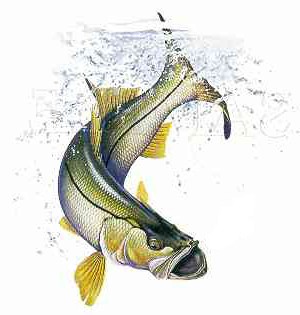
Snook Season Comes To An End


Snook anglers have until 11:59 p.m. tonight to keep the season's final two fish between 27 and 34 inches. Snook season will close tonight at midnight until Sept. 1.

While it will be strictly catch and release for snook until September, there is a strong possibility that anglers on Florida's Atlantic coast will have the bag limit reduced to one fish per person and the slot reduced to between 28 and 32 inches.

The proposed changes to the snook rules will be discussed at the Florida Fish and Wildlife Conservation Commission's meeting and final public hearing on the matter June 14 at the Radisson Suit Hotel Oceanfront in Melbourne. To see the complete agenda, visit www.MyFWC.com and see the news release.

Thursday, May 24, 2007

Ed's Best Bet: Tarpon on the prowl


By ED KILLER
edward.killer@scripps.com
May 24, 2007

They're here! That was the email I received last week from Capt. Joe Massaro with a photo of a leaping silver king at the end of someone's line.

In the background appeared to be High Point — the tip of Sewall's Point marking the spot as the Crossroads — the intersection of the St. Lucie River, Indian River Lagoon, St. Lucie Inlet and Manatee Pocket.


The annual migration of tarpon begin to show in good numbers along the Treasure Coast anywhere from late April into late May and generally the tarpon fishing can be quite good throughout the entire summer until the end of the fall mullet run in late October.

The windy weekend will likely prevent anglers from sight fishing opportunities for the silver kings, but with luck, we'll be able to start chasing them next week. Until then, look for them in residential canals and spots where land-based anglers can cast to them.

Here I'll try to run down a few spots to be on the lookout for the tell tale roll of the king of the game fish.

1. Roosevelt Bridge, Stuart. How is it that no matter what I'm writing about, this spot comes up.
2. C-23 Canal spillway, Bessey Creek, Palm City.
3. Crossroads, Stuart.
4. Big and Little Mud Creek, Hutchinson Island. Have to go into Big Mud down the road on the north side.
5. Blind Creek, Hutchinson Island.
6. North Fork, Five Fingers area, Port St. Lucie.
7. C-24 Spillway, Port St. Lucie.
8. Fort Pierce Inlet Jetty.
9. Taylor Creek, Fort Pierce.
10. Barber Bridge, Vero Beach.
11. Sebastian River.
12. Sebastian Inlet Jetty.

Tuesday, May 22, 2007

All About The Indian River Lagoon


A Lagoon is by nature a very shallow body of water. The Indian River Lagoon has an average depth of only 2 1/2 feet. Many of the mangrove islands were formed in the 1920's when the Army Corps of Engineers first dredged the ICW to allow safe inland navigation for large vessels. Vero Beach and the Indian River Lagoon is also the home of the famous Harbor Branch Oceanographic Institute.

Using giant dredges they would suck the bottom soil from middle of the lagoon and simply deposit it to either side. Eventually these deposits would sprout life in the form of mangrove seedlings, Autrailian Pine trees, and assorted types of palm, and palmetto shrubs. In time it has produced a beautiful and scenic ecosystem.

Mature coastal fish like the snook, redfish, sea trout, tarpon, various types of sharks, barracuda, and jack cravalle migrate into the lagoon after spawning to deposit their eggs or to simply feed. It's in this lagoon that many fish will spend the first 3 to four years of life before reaching maturity, thus replacing the previous stock, and then it all happens over, and over again. As you may suspect these predatory fish aren't the only ones to take advantage of the estuary.

The prey fish use this ecosystem as well, mullet, threadfin herring, grunts, croakers, pinfish, glass minnows as well as shrimp and assorted crabs. The current estimate is that more than 4,300 types of fish and animals utilize the lagoon at one time or another over the course of their lives. Bottle nose dolphin, manatees and otters are just a few of the mammals that also share this very bountiful universe.

Let's also not forget the additional life above the water line. The sea birds; Pelicans, gulls, the fish eating cormorants, Herons, Ibis,' mammals like; Raccoons, Squirrels, Opossums, Bobcats, reptiles such as; Green and Brown Anole lizards, Snakes like the Black Racer, the Banded Water Snake, along with numerous toads and insects even alligators.

Mix all this together and what you get is a macrocosm for all types of wildlife. Plenty of food for the smaller prey fish to eat around the mangroves, crabs, shrimp, and small minnows making up the majority of their diet. In turn while they're fattening up under the protection of the mangroves the predatory fish are feasting on them.

The lagoon system is a unique environment a constant migration of life, and naturally death. Now granted this is not a very scientific explanation but I'm not a scientist I'm a fisherman, and all I know is that it's beautiful system that nature has devised. The only natural enemy threatening it are humans.

Thursday, March 29, 2007

Treasure Coast fishing report: March 29

INDIAN RIVER COUNTY

Steve Parsons, at Wabasso Tackle, said the fishing at Sebastian Inlet has been erratic at best and is largely affected by the recent windy conditions. A few whiting are being reported from the beaches. Snook fishing is very inconsistent. Anglers who target a specific tide are finding that they need to cover more time and more tides to get a good catch. Fishing in the river has been on and off with trout being one of the most consistent catches. Offshore information is hard to come by.


ST. LUCIE COUNTY

Justin Coffin, at Billy Bones Bait and Tackle in Port St. Lucie, said the freshwater fishing around area ponds and canals has really dropped off. Most of the spawning period is over, he said. The North Fork of the St. Lucie River has seen a good showing of just-undersized snook in the mangroves and croaker and snapper at Rivergate Park. A good bite of large trout has been had at Bear Point in the Indian River Lagoon. Fish topwater plugs early on the sand bar for best action.

MARTIN COUNTY

<>Anglers are catching snook 10 to 20 pounds near area bridges and upstream in the South Fork of the St. Lucie River. Large jigs and live bait fished on the outgoing tide near the bridges has been the best bite. Trout fishing is fair in areas along the east shore of the Indian River Lagoon, such as Joe's Point in Jensen Beach and along the docks on Hutchinson Island. Offshore fishermen found a good dolphin bite with sailfish mixed in.

LAKE OKEECHOBEE

Capt. Mike Shellen, in Okeechobee, said bass fishing is strong on both wild shiners and Shaky Tail jigs. Fish are in 18 inches of water and low lake level conditions are making it difficult to get into well-known fishing spots. Anglers on their own should stay in areas with ample water depth such as the Kissimmee River, Indian Prairie Canal and parts of the Rim Canal. Mayan cichlids are taking red worms and topwater baits near J & S Canal.

Contact outdoors editor Ed Killer at edward.killer@scripps.com